

Over the the years, much of our work at Edtrax has focused on helping school systems make better investment decisions. Whether evaluating instructional technology, procurement strategies, curriculum adoption, operational efficiency, or new educational initiatives, the underlying question is remarkably consistent: How do we reduce risk while increasing confidence that our investments will produce meaningful educational outcomes?
As we’ve worked alongside district leaders, researchers, consultants, and implementation specialists, one observation has continued to surface. Despite the enormous volume of educational research published every year, much of it isn’t actually searching for the next breakthrough. Instead, it’s asking a much more practical question: Are we consistently achieving the outcomes we already believe are possible? That isn’t really discovery. It’s validation. And the more I thought about it, the more it reminded me of another industry where validation became so important it evolved into its own highly specialized discipline—the pharmaceutical industry.
More Similar Than We Think
When most people think about pharmaceuticals, they think about scientific discovery. In reality, discovery is only the beginning. Before a therapy reaches patients, it must be validated repeatedly to ensure the intended results are actually occurring—consistently, safely, and at scale. The questions become remarkably familiar: Is the product doing what it was designed to do? Is it being implemented consistently? Are the intended outcomes occurring? Can they be demonstrated repeatedly?
As we compared the two industries, the similarities became difficult to ignore.
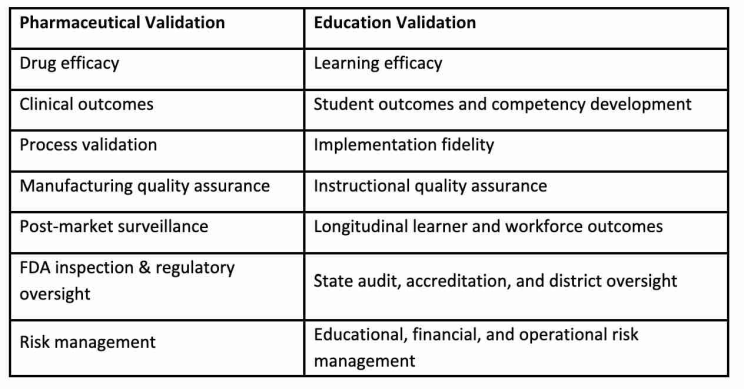
Perhaps education isn’t missing another breakthrough idea. Perhaps it’s missing a discipline dedicated to validating—and continuously improving—the practices we already know can make a difference.
Validation Is Different from Research
Research asks, “What works?” Validation asks, “Is what we implemented actually working here?” Research generates knowledge. Validation generates confidence. Confidence that an instructional strategy is being implemented with fidelity. Confidence that technology investments are improving learning. Confidence that professional development is changing classroom practice. And increasingly, confidence that public dollars are producing measurable educational value. Those are operational questions—not simply academic ones.
Educational Validation Extends Beyond Program Evaluation
Validation isn’t a single report or end-of-year evaluation. Like pharmaceuticals, it spans an interconnected system where success at one layer depends on every other.
Product Validation. Does the curriculum, assessment, tutoring model, or AI solution actually do what it claims? This establishes whether the intervention is capable of producing the intended learning outcomes.
Implementation Validation. Even exceptional programs fail when implementation varies. Were teachers trained? Was instructional time sufficient? Were interventions delivered consistently? Implementation fidelity often explains differences in outcomes more than the intervention itself.
Outcome Validation. Did students actually learn what was intended? Beyond test scores, this includes competency development, learner engagement, skill transfer, workforce readiness, and long-term educational growth.
Financial and Governance Validation. Did the investment create measurable educational value? Were procurement decisions sound? Should the initiative be expanded, redesigned, or discontinued? As fiscal pressure increases, validation becomes as much a financial discipline as an instructional one.
Complexity Creates Entire Industries
One of the biggest misconceptions about pharmaceutical validation is that it exists simply because of regulation. Regulation made validation mandatory, but complexity made it a profession.
Validation now spans research, clinical trials, manufacturing, quality systems, regulatory compliance, supply chains, patient safety, and post-market surveillance. No single organization or discipline can easily manage that complexity alone.
Education is becoming similarly interconnected. Today’s districts must simultaneously evaluate curriculum, instructional practice, assessment quality, AI, implementation fidelity, professional learning, procurement, financial sustainability, accountability, learner outcomes, workforce readiness, and public trust. No single department owns all of those questions. Increasingly, no single discipline does either. That’s exactly how new industries emerge.
The Future Is Confidence
At Edtrax, we don’t believe schools need more reports. They need more confidence. Confidence that educational investments are producing meaningful outcomes. Confidence that implementation is occurring as intended. Confidence that limited financial resources are being deployed where they create the greatest educational value.
Education doesn’t suffer from a lack of ideas nearly as much as it suffers from a lack of confidence that those ideas are being implemented well enough to achieve their intended results. Just as pharmaceutical validation became its own specialized discipline because the journey from scientific discovery to patient outcomes became too complex for any one organization to manage, education may be approaching the same inflection point.
The future may not belong only to organizations that create curriculum, assessments, or technology. It may belong to those that can independently validate that educational investments are delivering their intended results—and identify the operational levers that drive continuous improvement.
Sources
[1] U.S. Food & Drug Administration. Process Validation: General Principles and Practices. https://www.fda.gov/regulatory-information/search-fda-guidance-documents/process-validation-general-principles-and-practices
[2] Carnegie Foundation for the Advancement of Teaching. Improvement Science in Education. https://www.carnegiefoundation.org/our-ideas/improvement-science/
[3] National Institute of Standards and Technology (NIST). Quality Assurance Concepts. https://www.nist.gov/